
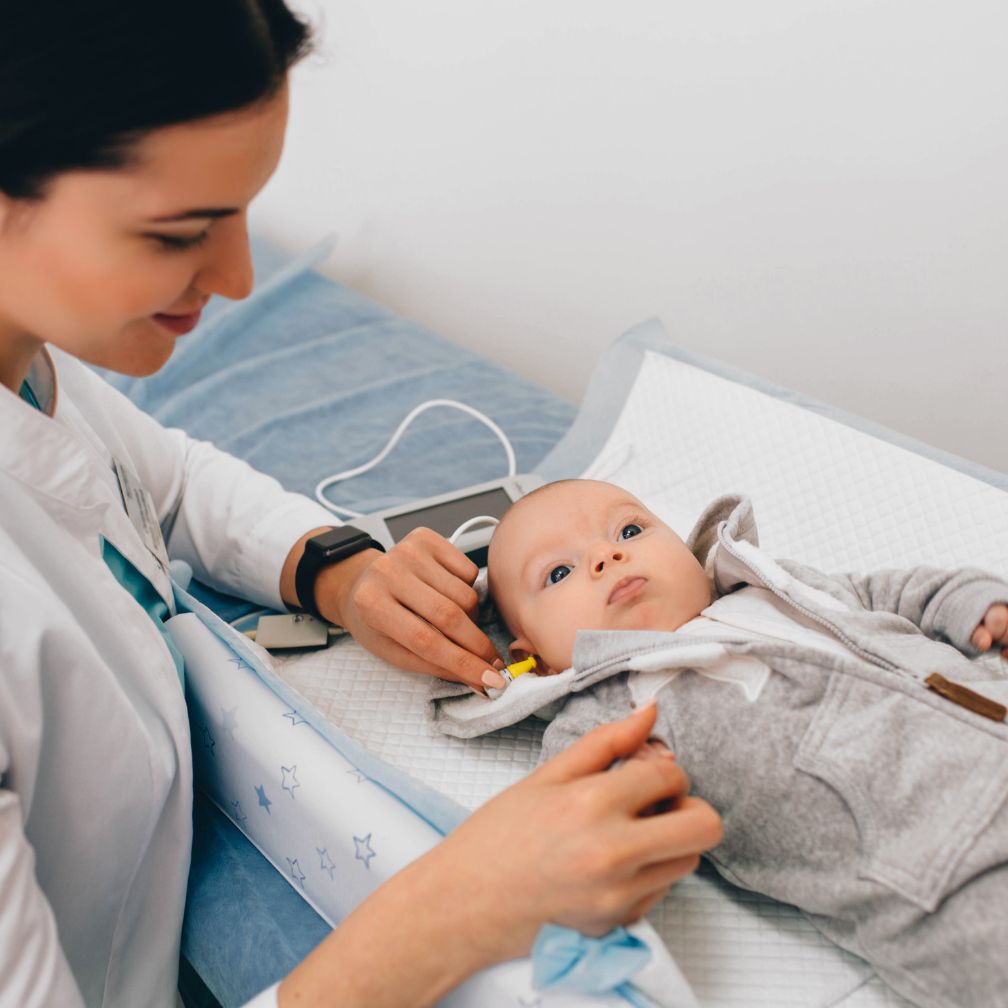
For early-stage parents, learning that their baby exhibits auditory issues almost always feels terrifying and sad. But the positive fact is that because of prompt medical testing and early intervention, young children with hearing deficits can truly thrive. Clearly, such children consistently gain language proficiency, interpersonal skills, and deep relationships with those around them, building toward a prosperous life!
Utilizing individual hearing aids alongside surgical cochlear implants provides two highly successful approaches for assisting infants with hearing loss. Within this guide, we review their operational methods to assist you in choosing the optimum pathway for your infant.
Unpacking the Foundations of Infant Hearing Loss
Auditory loss in newborn babies can be driven by diverse potential origins, including:
- Potential genetic predispositions (even without documented familial lineage)
- Congenital infections including cytomegalovirus (CMV) or German measles
- Physical birth-related trauma, such as neonate oxygen loss or premature delivery
- Specific pharmaceutical treatments deployed inside neonatal intensive units
What is the primary objective for parents? Prompt medical diagnosis. This critical mandate clarifies why infants in United States hospitals complete hearing tests before departing the nursery. Trained pediatric hearing clinicians consistently enforce the established “1-3-6” intervention timeline:
- Baseline hearing check completed by 1 month of life
- Formal comprehensive diagnosis completed inside 90 days of life
- Active management (incorporating hearing technology or specialized rehabilitation) established before 6 months of age
Meeting these procedural steps provides infants an optimal opportunity for healthy speech, language mastery, and brain development. In the event you want clarification regarding these testing procedures, your child’s pediatrician will gladly guide you!
Understanding Amplification Devices for Infants
For babies presenting with mild to severe auditory impairment, programmed hearing aids generally provide the recommended first step. These miniature, body-worn units boost ambient audio signals, enabling infants to perceive spoken words and environmental noise with greater clarity.
Customized infant hearing instruments operate as:
- Entirely safe for pediatric application in infants merely weeks post-birth
- Constructed using soft, skin-friendly ear inserts that adapt during early physical development
- Constructed with child-proof battery covers plus specialized safety features geared toward babies
- Precisely calibrated by an experienced pediatric audiologist to mirror your infant’s unique auditory curve
As your child matures, these hearing units require routine clinical adjustments to guarantee ideal ear-canal fit and maximum performance.
Understanding Cochlear Implantation for Babies
Should an infant present with profound to severe sensorineural hearing impairment and derives insufficient gain from wearable amplification, medical teams often recommend a cochlear implant. In contrast to conventional amplification tools, advanced cochlear implants:
- Must be placed via a specialized surgical procedure within the patient’s inner ear
- Safely route around damaged structures within the cochlear system
- Convert acoustic waves into precise electrical signals that activate auditory nerve fibers directly
Modern surgical cochlear systems operate as:
- Fully FDA-sanctioned for application in young infants starting at 9 to 12 months of age
- Most successful when supported by early speech therapy and active family involvement
- Prescribed solely after rigorous joint evaluations by an expert audiologist and ENT surgeon
That pre-surgical path incorporates radiological imaging, advanced hearing evaluations, and open dialogue concerning long-term communicative results.
Contrasting Hearing Aids with Cochlear Implants
- Mild to severe auditory decline uses Hearing Aids; Severe to profound hearing loss: Cochlear Implants
- Non-Invasive: Hearing Aids; Surgical insertion required: Cochlear Implants
- Acoustic sound amplification: Hearing Aids; Direct electrical signal generation: Cochlear Implants
- Starts at Infancy: Hearing Aids; Surgery can begin at 9-12 months: Cochlear Implants
Hearing Aids vs. Cochlear Implants: Final Thoughts
In the event your infant receives a hearing loss diagnosis, you possess multiple viable options and dedicated expert support. With the help of pediatric hearing specialists, a vast majority of children attain speech and language proficiency that rivals their normal-hearing peers.
Whether your youngster qualifies for external hearing aids or surgical cochlear implants, prompt intervention unlocks lifelong developmental success.
Do you need professional advice regarding your baby’s current hearing health? Call our clinic today for a complete diagnostic review and tailor-made care roadmap.